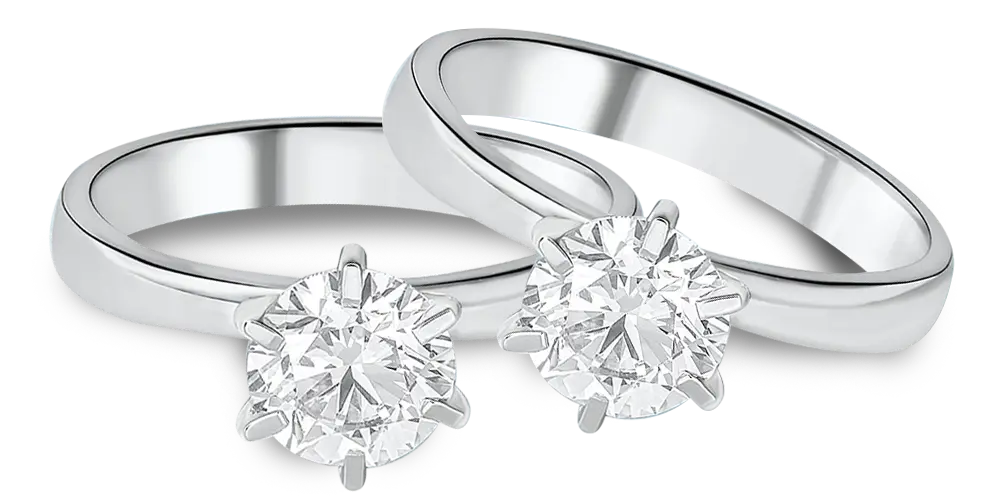
Getting your ring size right is the difference between a ring you forget you're wearing and one that spins, pinches, or slides off in the shower. A ring sizing chart is a helpful starting point, but there's more to a good fit than a single number.
This guide explains how ring sizing charts work, how to measure at home, the mistakes that throw sizes off, and when it's worth visiting a jeweler for a professional sizing.
How Ring Sizes Work
In the United States, ring sizes are measured on a numerical scale, usually in quarter- or half-size increments. Each size corresponds to the inside diameter (or circumference) of the ring. Other countries use different systems: the UK and Australia use letters, while much of Europe uses circumference in millimeters.
A standard ring size chart lists US sizes alongside inside diameter and circumference in millimeters. To use one, you measure either an existing ring's inside diameter or your finger's circumference, then match the number to the chart.
US ring size reference (approximate)
| US Size | Inside Diameter (mm) | Circumference (mm) |
|---|---|---|
| 4 | 14.9 | 46.8 |
| 5 | 15.7 | 49.3 |
| 6 | 16.5 | 51.9 |
| 7 | 17.3 | 54.4 |
| 8 | 18.1 | 57.0 |
| 9 | 19.0 | 59.5 |
| 10 | 19.8 | 62.1 |
| 11 | 20.6 | 64.6 |
| 12 | 21.4 | 67.2 |
These are standard approximate conversions used across the jewelry industry. Small variations exist between manufacturers' mandrels and sizers, which is one reason professional sizing matters for important rings.
How to Measure Your Ring Size at Home
Method 1: Measure a ring that already fits
- Choose a ring that fits the finger you're sizing.
- Measure the inside diameter edge to edge in millimeters, across the widest point.
- Match the measurement to the chart.
This is the most reliable at-home method, as long as the ring is round and fits the correct finger.
Method 2: String or paper strip
- Wrap a thin strip of paper or non-stretchy string around the base of your finger.
- Mark where it overlaps.
- Lay it flat and measure the length in millimeters. That's your circumference.
- Match it to the chart.
This method is easy but less accurate. String can stretch, and it's easy to pull too tight or too loose.
Method 3: Printable or plastic ring sizer
Adjustable plastic sizers and printable sizers are widely available. They can get you in the right range, but results vary with print scaling and how snugly you pull.
Common Ring Sizing Mistakes
- Measuring when your hands are cold. Fingers shrink in the cold and swell in heat. In the Arizona summer, your fingers may be a bit larger than in winter. Measure at a normal, comfortable temperature.
- Measuring first thing in the morning or after exercise. Fingers can be swollen then.
- Ignoring the knuckle. If your knuckle is larger than the base of your finger, the ring has to slide over it. A ring that fits the base may not get over the knuckle.
- Forgetting band width. Wide bands (around 6mm and up) fit tighter than narrow bands of the same size. You may need a quarter to half size larger.
- Measuring the wrong hand. Your dominant hand is often slightly larger.
Band Width and Comfort Fit
Wider rings cover more skin and feel snugger. Comfort-fit bands, which are rounded on the inside, slide on more easily and can feel looser than standard-fit bands of the same size. If you're buying a wide band, especially a men's wedding band, try on that exact width when possible.
When to Get Professionally Sized
At-home sizing works for fashion rings. For engagement rings, wedding bands, and anything expensive, a professional sizing is worth the short visit. A jeweler uses calibrated sizing rings in the same width as your ring, accounts for your knuckle, and can check your size more than once.
Professional sizing is especially important if:
- You're buying a wide band or a comfort-fit band
- Your knuckles are larger than the base of your fingers
- You're between sizes
- You're ordering a ring that's difficult to resize later, like an eternity band
- You're ordering custom work
At Brilliant Jewelry, we'll size you during a free consultation, with no pressure to buy anything.
Sizing for a Surprise Proposal
Trying to size a ring without your partner knowing? Borrow a ring they wear on the right finger and bring it to us, or trace the inside on paper. If you have to guess, guess slightly larger. Sizing down is usually easier than sizing up. Our guide on knowing ring size without measuring covers more tricks.
What If Your Ring Doesn't Fit?
Most rings can be resized. Gold and platinum bands are sized by cutting and adding or removing metal, then soldering and refinishing. Some designs are harder:
- Eternity bands with stones all the way around
- Tension settings
- Rings made from tungsten, titanium, or other hard alternative metals
- Rings with intricate engraving all the way around
For these, alternatives like sizing beads or spring inserts can help. We'll explain your options. See our jewelry repair services for ring sizing details.
Ring Sizes by Finger and Hand
There's no universal "average" size that will fit everyone, so don't rely on guesses based on height or hand size. Each finger, and each hand, can be a different size. If you're buying for a specific finger, size that finger.
Get Sized by a Mesa Jeweler
A two-minute professional sizing can save weeks of frustration. Brilliant Jewelry is a fourth-generation family jeweler at 1237 S Val Vista Dr Ste 204 in Mesa. We size rings, resize rings in-house, and help you choose the right fit for the band you love.
Book a free sizing appointment or call or text (480) 331-8652.