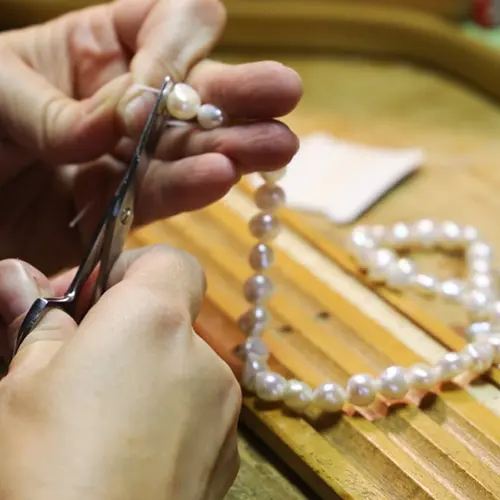
Pearl necklaces and bracelets are strung, not soldered. That means the thread holding them together is part of the jewelry, and like any thread, it wears out. Restringing is normal maintenance for pearls, and it's the best way to protect a strand from breaking and scattering.
This guide explains why pearls need restringing, how to tell when it's time, how the process works, and how to care for your pearls afterward.
Why Pearls Need Restringing
Fine pearl strands are traditionally strung on silk thread. Silk drapes beautifully and is gentle on pearls, but it:
- Stretches over time with wear and gravity
- Absorbs body oils, lotion, perfume, and moisture
- Weakens and can fray
- Discolors, turning gray or dingy
Eventually, the thread can break. Restringing replaces the old thread with new before that happens.
Signs Your Pearls Need Restringing
- Gaps between pearls and knots
- Thread looks dirty, gray, or frayed
- The strand feels longer or droops more than before
- Knots look loose
- The clasp is loose or worn
- The strand hasn't been restrung in a long time
How often pearls need restringing depends on how often you wear them. Strands worn frequently need it more often than strands worn on special occasions.
Why Knotting Matters
In a hand-knotted strand, a small knot sits between each pearl. Knotting:
- Prevents pearls from rubbing against each other, protecting their surface
- Keeps the strand intact if the thread breaks, so you lose at most one pearl rather than all of them
- Creates a fluid drape
Knotting is standard for fine pearls. Some beaded necklaces and bracelets are strung without knots, depending on the design.
The Pearl Restringing Process
1. Evaluation
The strand is examined: pearls, drill holes, clasp, and length. We'll discuss whether you want to keep the same length, change it, or update the clasp.
2. Cleaning
Pearls are gently cleaned by hand. Pearls should never go in ultrasonic or steam cleaners.
3. Laying out the strand
Pearls are kept in their original order, especially on graduated strands where pearls get larger toward the center.
4. Selecting thread
Thread thickness is chosen to fit the drill holes snugly so the knots sit properly.
5. Stringing and knotting
Each pearl is strung and knotted individually.
6. Attaching the clasp
The clasp is attached securely, often with protective thread guards (gimp) at each end.
7. Final check
The strand is checked for even knots and proper drape.
Clasp Upgrades
Restringing is a great time to upgrade your clasp. Options include:
- Fish hook clasps - traditional, but can wear.
- Box clasps - secure with a safety latch.
- Ball and socket clasps
- Magnetic clasps - easier for people with limited dexterity, ideally with a safety feature.
- Decorative clasps - can be worn to the side as a feature.
Changing Length or Style
While restringing, you can:
- Shorten a long strand
- Lengthen by adding pearls or an extender
- Convert a long strand into a necklace and bracelet set
- Create a double strand or layered look
Restringing Beaded Jewelry
We also restring beaded necklaces and bracelets: gemstone beads, glass beads, and stretch bracelets. Materials vary: silk, nylon, wire, or elastic, depending on the beads and design. See bead restringing.
Pearl Restringing Cost Factors
- Length of the strand
- Number of pearls
- Knotting vs. no knots
- Clasp replacement
- Multiple strands
- Design changes
We'll quote before beginning.
How Long Does Restringing Take?
Timing depends on the strand and our schedule. We'll give you a timeline when you bring your pearls in.
Caring for Restrung Pearls
- Last on, first off - put pearls on after makeup and perfume.
- Wipe after wearing with a soft, damp cloth.
- Lay flat to dry, never hang wet pearls.
- Store flat in a soft pouch, separate from other jewelry.
- Avoid chlorine, salt water, and chemicals.
- Don't hang strands for storage.
See our pearl necklace care guide and jewelry care tips.
Inherited Pearls
Many people inherit pearls that haven't been restrung in years. Restringing can bring them back to life. An appraisal can document their value.
Pearl Restringing in Mesa
Brilliant Jewelry is a fourth-generation, family-owned jeweler at 1237 S Val Vista Dr Ste 204, Mesa, AZ 85204. We restring pearls and beads in-house and serve the East Valley. Learn more about pearl and bead restringing.
Book a pearl restringing appointment or call or text (480) 331-8652.